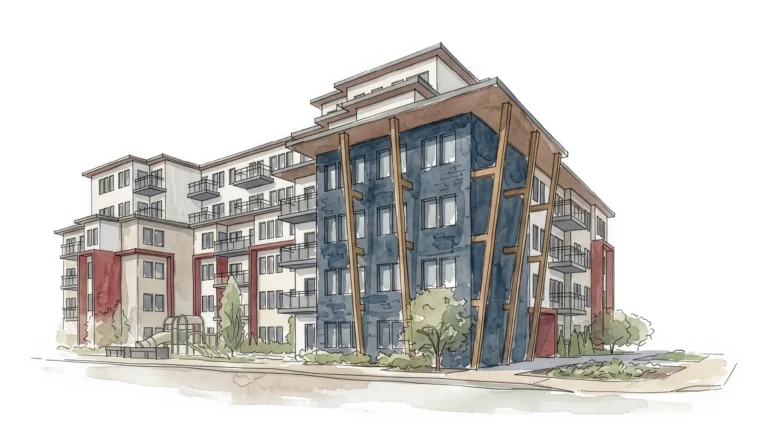
Canada is in the grip of a housing crisis the likes of which we’ve not seen in peacetime: rapidly escalating prices, shortages in affordable housing, long delays in construction, labour shortages, and regulatory hurdles at every turn. Against this backdrop, modular and industrialized construction are emerging as key tools in Canada’s strategy to build homes …
Canada is in the grip of a housing crisis the likes of which we’ve not seen in peacetime: rapidly escalating prices, shortages in affordable housing, long delays in construction, labour shortages, and regulatory hurdles at every turn. Against this backdrop, modular and industrialized construction are emerging as key tools in Canada’s strategy to build homes faster, cheaper, and smarter. The federal government’s recent moves indicate a serious commitment to turning modular homes from niche experiments into mainstream housing solutions.
What Modular Homes Are & Why They Help
Modular homes (sometimes called factory-built or prefabricated/hybrid homes) are structures whose major components are manufactured off-site in controlled factory environments, then transported to and assembled at the building site. The advantages are well documented:
-
Speed of construction: Because much of the work happens in factories shielded from weather, many stages (foundation, framing, finishing) can proceed in parallel rather than waiting on site conditions. This cuts building timelines substantially. Experts point out modular homes can be delivered in weeks or a few months, compared to the many months or even years often required for conventional site-built homes.
-
Cost savings & affordability: Modular methods offer potential savings due to efficiencies of scale, reduced labour waste, fewer delays, and lower exposure to unpredictable site-based costs. Estimates suggest cost reductions of 20-35% are possible in favourable cases. At a minimum, practitioners expect at least 10-20% savings once volume, standardization, and stable demand are in place.
-
Quality, consistency, and sustainability: Factory settings allow better quality control, tighter tolerances, and less waste. Environmental benefits include lower material waste (up to ~50% less in some estimates), reduced emissions during construction, and the ability to integrate energy-efficient, climate-friendly design more easily than in unpredictable field conditions.
-
Predictability and labour force benefits: Modular factories can run under more stable schedules, with less exposure to weather delays or supply chain disruptions. This kind of predictability attracts investment, lets factories run in multiple shifts, and helps train and retain skilled labour. For tradespeople, instead of “chasing jobs” from site to site, there’s more continuity and potentially better working conditions.
-
Problem solving where conventional builds struggle: In many parts of Canada, the combination of cold winters, remote or difficult terrain, fragmented regulation, rising material costs, and labour constraints make traditional builds slow and expensive. Modular helps smooth over many of these issues. It can also help municipalities respond quickly to urgent housing needs (e.g. supportive, social, or transitional housing).
What Canada Needs & What the Government Is Doing
To give a sense of scale, Canada needs to build millions of new homes by 2030 just to begin easing affordability and supply pressures. Some reports place the number around 3.5 million additional homes needed, especially in affordable and non-market housing sectors.
To respond, the federal government has launched Build Canada Homes, a new agency with a budget in the ballpark of $13 billion to finance projects aimed at affordable housing, including strong encouragement (or requirement) that those projects use modular and prefabricated methods.
Key features of the strategy:
-
Federal procurement of modular units (bulk ordering) to help stabilize demand.
-
Making use of modern technology and off-site building methods a condition in many of the deals facilitated by the new agency. Projects that wish to access federal funding are often required to integrate modular construction, prefab techniques, or other “building technologies / innovation.”
-
Support for manufacturing capacity, including capital investments in factories or building tech, to allow for scale.
-
Efforts to harmonize codes, reduce permitting and regulatory delays, and standardize designs to allow easier replication of modular units across provinces and municipalities.
The federal government is also watching international examples. Countries like Sweden, where factory-built homes represent a very large share of the housing market (almost 50% in some cases), offer proof that large scale modular housing is possible.
Why Gregor Robertson Matters — What His Background Brings
Gregor Robertson, the current Minister of Housing and Infrastructure, is central to this shift. Before entering federal politics he was well known as Mayor of Vancouver (2008-2018) and for his early support of modular and temporary modular housing programs. For example, under his leadership Vancouver implemented temporary modular housing projects to respond to homelessness, deploying units on underused or city-owned land with supportive services.
After his mayoral term, Robertson worked in the modular building / building-technology sector: he was Executive Vice-President of Strategy for Nexii Building Solutions, a firm that attempted to scale up prefab / panel-based methods and greener alternatives to traditional materials. That gave him first-hand exposure to both the promise and the pitfalls of trying to scale modular construction: issues around capital, supply chains, demand, regulation, and execution.
Now, as minister, Robertson appears to be pushing for the kinds of conditions that sector insiders have long argued are necessary: steady demand, certainty (through policy, regulation, finance), and incentives or requirements for the industry to modernize. His background gives him credibility when setting expectations (e.g. making modular or modern methods a condition in government-funded builds), and also likely informs his awareness of what challenges need early intervention (such as upfront financing, provincial/municipal code harmonization, regulation, risk management).
Risks & What Still Needs to Be Addressed
Despite all this promise, modular homes are not yet a magic bullet. Some of the biggest challenges include:
-
Financing & upfront cost: Factories need capital, and modular manufacturers must order or hold materials in advance. Lenders are often wary because returns may be slower or less certain, and there’s more upfront risk.
-
Demand certainty / order pipelines: Without guaranteed or predictable demand, factories remain under-utilized or hesitant to expand. Boom-and-bust cycles (often the norm in construction) undercut confidence in long-term investment.
-
Regulatory and code fragmentation: Building codes, permitting, zoning, and inspections are handled by provinces, municipalities, sometimes individual local authorities. Differences in interpretation, slow approvals, or local resistance can significantly delay modular projects or drive up cost.
-
Transportation, logistics, and site-assembly costs: Even when factory work is efficient, moving large modules or panels can be expensive (especially in remote areas) and installing them on site involves coordination, crane work, foundation preparations, etc.
-
Public perception, livability, design flexibility: Some communities resist modular housing (temporary or otherwise) due to perceptions of lower quality, less architectural variety, concerns about density or neighbourhood fit. For supportive housing or emergency housing programs, there are also social services, site planning, and community integration issues.
Looking Ahead: What 2026 and Beyond Could Bring
If all the pieces fall into place, 2026 could be a turning point. Here’s what needs to align:
-
Stable, sustained federal and provincial/municipal policy: Consistent funding, procurement programs, regulation, and incentives are essential. The Build Canada Homes agency is a strong signal in this direction.
-
Capacity scale-up: More factories, more building-technology firms, more performers who can manufacture in both quantity and quality. Factories need to run at high utilization to bring down costs per unit.
-
Harmonized regulation: If provinces and municipalities standardize codes, permitting, and inspections for off-site building methods, this will reduce delays, costs, and duplication.
-
Demand anchors: The government needs to anchor demand via bulk orders for affordable / social housing, and also encourage (or require) modular in private housing developments.
-
Risk management and forecasting: As Atul Bhatt and others have noted, there are many risk factors in large modular projects. The government’s role in forecasting demand, establishing risk-ratings or risk mitigation mechanisms (financial, regulatory, logistical), and ensuring that projects are delivered on time and quality is essential.
Why This Matters — For Canadians
-
Improved access to affordable housing: Modular methods promise accelerated delivery of affordable and non-market housing, which means sooner relief for households strained by rising rents.
-
More efficient spending of public money: Faster builds, fewer delays, less waste, and better cost control mean that public budgets stretch further.
-
Better environmental outcomes: Less waste, better energy performance, lower greenhouse gas emissions in both construction and operating phases.
-
Labour force development: Modular construction could create new kinds of jobs—factory work, logistics, advanced manufacturing—offering alternative paths for skilled tradespeople.
-
Community benefits: Faster housing delivery can help with homelessness, housing precarity, the need for shelters or supportive housing, while also helping municipalities plan land-use more effectively.
Conclusion
Canada has begun a serious, well-funded push towards modular and industrialized construction—not as an experiment, but as a strategy for solving urgent housing deficits. With Build Canada Homes, with financial incentives, regulatory reform, and demand anchoring, 2026 could mark the moment when modular becomes more than a fringe solution—it becomes part of how we build a better, more affordable, more sustainable housing future. Gregor Robertson’s industry experience and policy vision are helping shape that trajectory, giving both credibility and insight into what needs to be done and what pitfalls to avoid.